From Legacy to History: The End of the Post-WWII Era
 Modern geopolitics has been largely defined by a series of international settlements under which all major powers have operated. We can think of these settlements as the operating environment in which foreign relations are conducted. In most cases, these settlements come about as the result of a major war that results in a new geopolitical reality. Old powers are brought low, and new powers rise to take their place. The defeat of the Spanish Armada in 1588 ended the Age of Exploration. Spain, previously the richest and most powerful nation in the world, began to decline as England became a major force in world politics, and created its own empire.
In earlier times, these types of post-war settlements were often quite limited, and only applied to a small number of nations. But, after the 16th century, when nations were able to increasingly extend their power across the oceans, these settlements became more inclusive, creating a more global international order.
These settlements, of course, are not eternal. They encapsulate the national power differentials as they existed at the end of the previous conflict. They work for a while, but ultimately, those national power differentials change. When they change sufficiently, the existing settlement no longer works, and no longer accurately reflects the current geopolitical situation. When the existing settlement no longer works, the time is ripe for chaos.
In the modern era, there have been two major international settlements. The first one ended in 1914. The second is ending now. Let’s talk about them.
Au Revoir, Napoleon
In 1814-1815, at the end of nearly twenty years of constant warfare against Napoleonic France, the nations of Europe held a series of conferences known as the Congress of Vienna, led by Austrian diplomat Klemens von Metternich. Nearly every European nation had been involved in the Napoleonic Wars, and the purpose of the Congress of Vienna was to establish a new international order to achieve permanent peace through negotiation. Beyond that the Congress tried to turn back the clock on the French Revolution to restore the French monarchy, as well as the Bourbon monarchy in Spain. In essence, they re-established a more conservative, traditional political order.
While largely successful, it certainly wasn’t permanent and required adjustments along the way. In 1848, during the revolutions of that year, the French monarchy was overthrown, and the Second Republic was created, though it was soon replaced by the Second French Empire. Starting in 1848, the Italians, in a series of local conflict and unification wars, slowly unified their country in 1861. In 1866, the “Germanies”, as they were then called, also began the process of uniting into a single German nation, led by the Hohenzollern monarchs of Prussia. This move towards unification led to a war with France, which Germany won, fully solidifying and formalizing German unification in 1871.
The post-Napoleonic settlement began to look increasingly shaky. By the late 1880s, Germany, Austria, and Italy had formed the Triple Alliance, with France, Russia, and the United Kingdom creating the Triple Entente. The two alliances were designed to separate Europe into a balance of power that would preserve peace. No one would go to war, it was thought, because it would almost certainly result in a general war between all of the European powers. All right-thinking people would, of course, want to avoid such a war at all costs. But general war in Europe is exactly what happened in August of 1914.
The post-Napoleonic settlement reflected the state of political and military power of 1814 Europe, not the state of affairs that existed in 1914. In 1814, there was no Germany or Italy. There were no systems of permanent and opposing alliances. There had been no 1848 revolutions to undermine the traditional, conservative government of Europe.
In 1919, the Treaty of Versailles attempted to create a new international order, but one which was doomed to failure. One of its chief deficiencies was to try to make Germany a permanently weak state through excessively punitive requirements. Given Germany’s potential military and industrial might, this punishing and unrealistic treaty was almost certain to fail, and in short order. While it may have satisfied some of the allies’ urge to punish Germany, it also caused enormous resentment in Germany. At the same time, the collapse of the Austro-Hungarian empire and Czarist Russia, along with the downfall of many of Europe’s pre-1914 monarchies, left behind a power vacuum, making any permanent settlement enormously uncertain.
Europe, therefore, tottered along for the next 20 years, until the rise of Naziism in Germany resulted in Germany throwing off the shackles of Versailles, and attempting to renegotiate the international settlement by conquering all of Europe. They were joined in this endeavor by fascist Italy, under Benito Mussolini, with the goal of imposing an Italian empire in North Africa, with German help.
Meanwhile, in Asia, the Japanese civil government had largely been taken over by the country's armed forces. They were keen to embark upon a great imperial project of their own in Asia. Japan had been allied against Germany in WWI, but Western disapproval of Japan’s imperial ambitions, prompted by the invasion of China, led to both a souring of relations with Great Britain and the United States, and, ultimately, an alliance with Nazi Germany.
Germany, Italy, and Japan formed the Axis Powers that plunged the world into a second global war in 1939. Most of the world formed an alliance called the United Nations to defeat the Axis powers, which they did in 1945.
Pax Americana
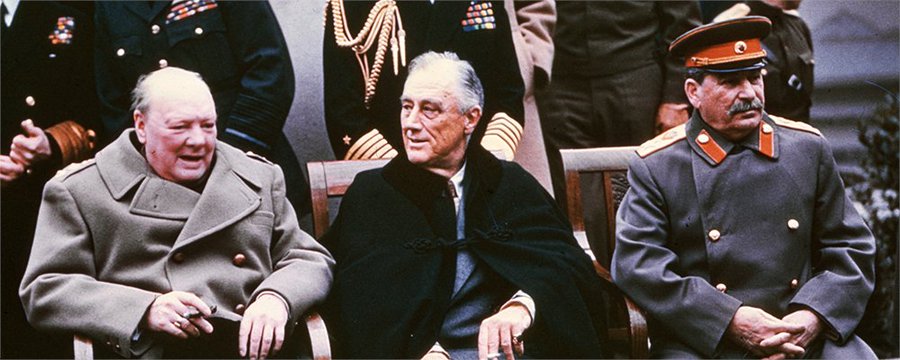
Starting with the Yalta Conference in 1945, where the “Big Three” powers of the United Nations, the UK, US, and USSR, met to discuss the post-war shape of Europe, the United Nations hammered out a postwar international settlement. The rapid cooling of relations between the USSR and the US made this somewhat more difficult, and by 1948, the Cold War had begun. Nevertheless, the shape of the postwar settlement slowly took place in the decade following the end of the war.
- The United Nations would form a global security organization, with the same name, to provide a central nexus for international relations, negotiation, and international cooperation. All nations would be allowed to join, though the primary victors of WWII, the US, USSR, UK, France, and China, would have veto power over UN decisions.
- The USSR would maintain a sphere of influence in Eastern Europe via proxy states that would serve as a buffer between the USSR and the West.
- The United States would use its navy to protect free global trade, and its other military forces to impose “peace” and “stability” where it was thought prudent.
- Western Europe would be protected by America’s nuclear umbrella and military forces from potential Soviet aggression.
- Eastern Europe would be protected by the Soviet nuclear umbrella and military forces from Western aggression (and also keep their occasionally recalcitrant “allies” in line).
- A bi-polar world, each headed by one of the two nuclear superpowers, the US and USSR, made general war between East and West unlikely via the threat of Mutual Assured Destruction, which would destroy a good portion, if not most, of the world.
- Military conflict would be limited to minor, “brushfire” wars as a proxy for direct Superpower conflict.
- The US dollar would serve as the reserve currency for international settlements in most of the world, and US financial markets would be open for investment and financing.
Essentially, the world became divided into two distinct camps, each of which would compete robustly with the other, though always short of direct conflict between the Superpowers. The United States would guarantee freedom of the seas for global trade and would contain Soviet—and, after 1949, Chinese—expansion, where possible. This new bi-polar international settlement, while at all times uneasy, and occasionally terrifying…worked. Both Superpowers had their spheres of influence and client states, and both ensured that those clients never did anything too crazy, restraining them when necessary.
There were some changes to the Post-WWII settlement along the way. The republic of China was overthrown by Mao’s communist forces in 1949, leaving behind a rump state, Taiwan, on the island of Formosa. In the 1960s, both the French and British empires formally ended. Governments were overthrown and replaced by regimes allied with either the US or USSR. America had its experience in Vietnam, and later the Soviets had a similar one in Afghanistan. But these changes were all peripheral to the dominant paradigm of a bi-polar world, which was the central reality of the Post-WWII settlement.
That reality, however, came to a rapid end between 1989 and 1991. The USSR simply collapsed the economic and political demands on the USSR outstripped their ability to keep their satellite empire intact. Starting in 1989, the USSR lost control of their Eastern European proxies. The process was mostly peaceful, though Yugoslavia descended into a brutal civil war. In 1990, East and West Germany re-unified. And, of course, the Soviet Union itself dissolved in 1991. The remaining Russian Federation successor state, while still armed with nuclear weapons, was economically cripped, with rising poverty, crime, and unrest at home taking up too much attention to involve itself in USSR-style international meddling.
The entire post-WWII settlement was undone, and President George H.W. Bush declared that we were entering a “new world order”. Though, as it turns out, there hasn’t been much “order”.
New World Disorder
The follow-on effects of the USSR’s collapse have had far-reaching implications.
With Soviet support, many regimes in the Middle East were able to keep the lid on Islamic fundamentalism. Without it, and with Iranian and Saudi meddling, Islamist forces have grown more powerful, and have been able to extend terror networks across the entire region. While this led to 9/11, and two decades of military involvement in the Middle East, the US failed to achieve much more than the status quo ante. This unsatisfactory result has led to a domestic pushback against US military interventionism generally, and the defense budget specifically. There’s increasingly little domestic interest in the US being the world’s policeman. Even if we can still project force anywhere in the world, it’s becoming an open question whether the electorate will stand for it, absent a direct and cognizable threat to the country itself.
America’s appetite for debt has ballooned dramatically, leaving us with $36 trillion in national debt, and an additional $55 trillion (at least) in unfunded Social Security obligations. Interest on the national debt now takes up $1 trillion annually. At this point, Social Security, Medicare/Medicaid, and debt service cost more than all the tax revenues the US government collects every year. Every penny we spend on the departments of Defense, Commerce, Treasury, Justice, etc. is borrowed. This unsustainable level of debt is pushing us ever closer to a default on our debt.
If that happens, the US will almost certainly lose its status as the world’s reserve currency, which would cause trillions of dollars in cash, currently held in foreign hands, to come flooding back into the US. This could spark massive inflation, perhaps hyperinflation. The inevitable resulting cuts to, among other things, defense spending, means that the US guarantee of global freedom of the seas and trade will have to end, because we’ll be incapable of providing it. But, even if we avoid that, the only option open to do so is massive cuts in government spending, which again, will have to fall greatly on defense, since it's the largest portion of discretionary spending, by far. Either way, we aren't going to have a Reagan-era 600-ship navy to patrol the seas and secure global trade routes.
Nor is there any immediate prospect of anyone stepping into fill our shoes. There’s no globe-spanning Royal Navy, for instance. Without the threat of military retaliation, chances are high that other states, or even non-state actors, will move to make global trade less secure.
There is the positive factor that there’s no financial market outside the US with the power and flexibility of our markets. It's one of the few bright spots in the picture. But even that is imperiled by the debt we've amassed.
It’s precisely at this moment of vulnerability that China is making ever more threatening moves on Taiwan. They’re embarked on a rapid defense growth and modernization program. Meanwhile, a Russian Federation that’s recovered from the economic and political chaos of the 1990’s has been flexing its military muscle against Georgia and Ukraine. The best evidence is that bad actors are no longer as constrained as they once were by US deterrence.
Whatever you might say about the bi-polar world of the Cold War, and the international settlement under which it operated, it was at least stable. The players were known, and the rules of the game well understood. But that world is gone, probably forever. The post-WWII settlement no longer fits the world in which we live. The last time the generally agreed-upon international settlement fell apart, we got two world wars. If we don’t want that to happen again, we need to figure out what the new international settlement needs to be.